Are you part of Gen-Z or are you a Millennial? Perhaps you’re a Gen-Xer or maybe a Baby Boomer? These categorizations may seem like harmless fun to most people, but anyone in the business of marketing knows all too well that you can assume a lot about a person simply by knowing their age; even if you’ve never seen or talked to them.
In the marketing world, we use these groupings to describe how people consume digital content. In that at least, the Internet has failed to fulfill detractors’ predictions that it would isolate us from one another.
But, even with our demographic differences and varied personas, we do all share at least one thing in common online: a desire for a great experience. Whether we want to connect with our friends, be entertained, feel better about ourselves and the world around us, or just want to kill some time waiting on 5 o’clock to roll around, rarely do we tolerate online mediocrity.
And that’s something we can build on.
Building Your Customer Experience Foundation
Nearly 40 years into the recognized “digital age” we are still refining our understanding of how we can use digital technology to connect with each other. That goes double for businesses wanting to connect more with customers and ultimately “sell more stuff.”
“More than half of consumers say that the overall enjoyment of their experience is important in their decision to buy a product or service.” – The Deloitte Consumer Review
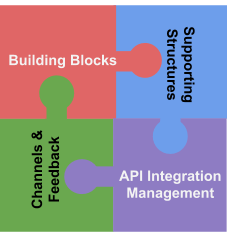
One of OutSystems most trusted partners, Deloitte, recently outlined six Building Blocks that will help you define and implement a winning customer experience architecture. Let’s look at them here briefly:
- Content – Content is the only way to reach digital audiences. Digital content can be as complex as interactive demos and augmented reality, or something as simple as a form. Regardless, it must be created and delivered in a frictionless way that makes people want to interact with you, even if all they “get” from it, is entertained.
- Customer Marketing Data – If Content is King, then customer marketing data is Content’s Big Brother. Without actionable marketing data, you have no insights into what your customers want, or what kinds of things they like. You might as well stand up in the food court at the mall with a megaphone and try to pull in prospects.
- Customer Data Repository – So now you have all this customer data, but without a good way to store it and access it, it’s not doing anyone any good. From a storage standpoint, we have data warehouses and cloud storage solutions. Both are good, and when properly implemented with good data handling processes, can provide enormous value across the enterprise, from marketing to operations.
- Marketing – How you get your content and message to your customers. Despite advances in technology, some of the oldest marketing technologies–video, email, webinars, blogs–are still some of the most effective. It’s how we present them and the information we present through them, thanks largely to the prior three steps, that makes all the difference.
- E-Commerce and Offline Sales – Depending on both the size and type of your business, you may favor one or other, or even both. Either way, your sales efforts can be driven more effectively through better and more informed digital offerings and communication.
- Service – Many businesses have realized the value of offering service as a service, either as an add-on after a sale, or by offering “service” as a product. In Deloitte’s survey, 58 percent said they prefer buying services online versus in-store. Service is a very important and profitable business model and can be more important from a “experience” standpoint as the the process leading up to a purchase.
To help you remember these Building Blocks, we offer this anagram: Cool Customers Can Make Everything Super. You’ll thank us later.
Three Ways to Reinforce Your Customer Experience
Foundational building blocks are great, but they are only what their name implies: parts of a larger structure. Necessary? Yes. But not sufficient on their own to build a successful customer experience. For that, you need support. Let’s look at the the three support beams Deloitte outlines.
Analytics
“Legendary customer experiences are designed.” – CX Consultant, Dwayne Vera
Maybe what Mr. Vera said there isn’t earth-shattering news to you, but it is one of the most important truisms in marketing. Two decades ago when customer experience extended no further than the checkout counter, then yes, great customer experiences could just happen. But not today. Not when we have dozens of potential touchpoints available to us within mere seconds of a thought.
If you want to design a great customer experience, you need to understand your customers and that can only happen through, initially, trial and error, and then later, through more intelligently gathered and analyzed data run through analytics.
How you gather that information is partly driven by your touchpoints. Within your apps, you should include feedback mechanisms throughout. In addition to passively providing feedback links and fields, ask for it. You’d be surprised how much more you’ll get just by asking. Other avenues of feedback include call centers, surveys, and email. If you’re just starting out, you may not have robust feedback mechanisms in place, but as you grow your customer channels, so should you expand and improve your feedback and analysis acumen.
When it’s time to analyze that feedback, we recommend one-plussing your human analysis with software-based analysis. As good as the human brain is, its abilities pale in comparison to computers when it comes to sorting and making connections between data points. If you can collect your data on the same system running your applications, you’ll definitely save yourself some time. If that’s not a luxury you have currently, there are work-arounds.
API Integration Management
An API is a software layer that, in short, makes it possible to integrate one piece of software into another. Most commonly, APIs tie in third-party data and functionality into a larger piece of software. For customer experience, we can use APIs to pull in other sources of analytics data and other product or service functionality to extend our own.
There are four main types of APIs: Open, Public, Composite, and Internal. On top of those four, are additional, web-based APIs: SOAP, REST, XML-RPC, and JSON-RPC.
Clearly, API integration isn’t something just anyone can pick up. Traditionally, it’s done by professional developers and though true that many vendors now offer an API for ease of integration, it usually requires a skilled hand to make it all work together. However, new developer-friendly tools like low-code platforms can greatly simplify API integration. They can make it so simple, in fact, that even non-professional developers (AKA Citizen Developers) can use them to create powerful software that integrates other data and functionality into their own.
Contextual Delivery and Personalization
With your APIs in place and a thriving analytics program plugging away, you can now truly begin to customize your touchpoints and channels to meet your customers wherever and whenever they want to interact with you.
We said “meet” because customer experience is not a “push-only” strategy. The best relationships happen organically, not through some forced marketing interaction. And not everyone wants to talk to a live person. For others, the very idea of an intelligent chatbot is too reminiscent of Skynet and the Terminator. And that’s OK. That’s why there are a dozen different ways to interact with people. The goal is to let them decide, but then provide them with a consistent, intuitive experience from Channel A (chatbot) to Channel B (your website) to Channel C (your product page).
Opening the Doors to a Great Customer Experience
With everything in place, you’re ready for the Grand Opening. How you reach out to your customers and the opportunities (channels) you provide them to reach out to you could be considered “Tactics” but that doesn’t sound nearly as good as “Experiences.”
A caution though; many organizations get so caught up in their online presence that they forget about their offline audience. Conversely, many smaller companies don’t believe they have a need for online channels, when often that’s the first place people go for information about them.
A balanced approach is best. Start simple and build from there. You may not need a 24×7 AI-based chatbot answering questions at all times of the day or night. That said, with an enterprise-class rapid application development platform, building and releasing a chatbot might not be that difficult, or expensive so why not?
Some traditional and popular experience channels today include:
- Email (includes targeted outreach and surveys/research requests)
- Web (multiple options here: landing pages, .com sites, ads, web apps, blogs, etc.)
- Mobile app
- Social Media/Networking
- Live Chat and/or AI-assisted Chatbots
- AR/VR
- Webinars
- Live phone support
- Attending or hosting events and roadshows
Your options are limited only by your resources, but at least for your online experience channels, there is some help.
Low-Code Application Development Platforms – Your One-Stop Customer Experience Workshop
Whether you run a small business trying to get a leg up on your competition and need to get started with your digital channels, or you’re part of an enterprise facing challenges around ageing legacy systems, budget shortfalls, and staffing concerns, a low-code development platform offers more than hope — it offers RESULTS.
- According to Gartner, “By 2024, low-code application development will be responsible for more than 65% of application development activity.” [1]
- 41% of organizations are already using a low-code application development platform.[2]
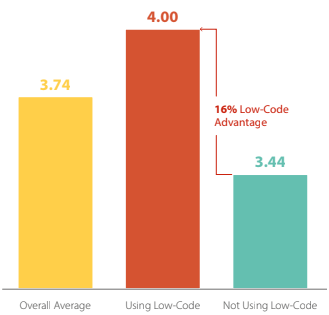
- From OutSystems own survey of more than 3,300 IT professionals, the following graphs shows the difference in Digital Transformation Maturity between those using a low-code development platform and those who do not:
An enterprise-worthy low-code platform offers anyone with a technical mindset–skilled developer or not–the ability to create amazing, feature-rich customer experiences entirely on a single platform. With low-code, you don’t need UX/UI specialists and a team of dedicated CX engineers to give your customers the same great touchpoints that you want when you connect with your favorite brands.
This is not to say that the library of screen templates and patterns that come preloaded are everything you need. But, they’re more often than not, a great start from which you can begin to customize as your own. And unlike niche-platforms that only serve a single business purpose, an enterprise-class low-code platform can help you build everything from core systems to edge solutions, all on a single platform.
We invite you to see for yourself what a low-code platform, like OutSystems, can offer. You can download the “OutSystems Personal Environment” and get started with it today.
If you would like to learn more about the ideas discussed in this blog, check out these great articles and resources:
- How to Build and Use APIs with Low–Code
- Get a copy of the Gartner “Critical Capabilities for Enterprise Low–Code Application Platforms (LCAP)” report. It is a supplement to the full Gartner Magic Quadrant for Low–Code Application Platforms, which details some of the analyst firms’ CX requirements for low-code platforms.
Customer Stories – OutSystems for Digital Experiences
[1] 2019 Gartner Magic Quadrant for Enterprise Low–Code Application Platforms.
[2] The State of Application Development – 2019, OutSystems https://www.outsystems.com/1/state–app–development–trends/
From page 37 of the 2019 SOAD report.

 Marcom Today - Portfolio site of Chris Souther