Table of Contents:
Introduction
Step 1: Know Thyself
Step 2: Know Your Customer
Step 3: Determine Your Content Marketing Goals
Step 4: Search Engine Optimization
Step 5: Perform a Content Inventory
Step 6: Content Mapping
Step 7: Creating Content
Step 8: The Right Content in the Right Channel
Step 9: Measuring Your Content Strategy’s Success
Some Final Thoughts
It’s very unlikely your current content strategy is completely wrong. In fact, you’re probably doing a lot of things right and just need to focus and plan. This means you probably already have some very good content you can update, rechannel, and reuse.
Content inventories can be a tedious task, but they are critical as you baseline your current state of content readiness. There are software solutions to simplify this task, but you can also do-it-yourself with a little help from Google Analytics and a spreadsheet.
Start by inventorying all of your current content:
- Web properties
- Digital documents
- Blogs
- eBooks
- Webinars
- Videos
- Sales enablement (brochures, datasheets, etc.)
- Case Studies/Customer Stories
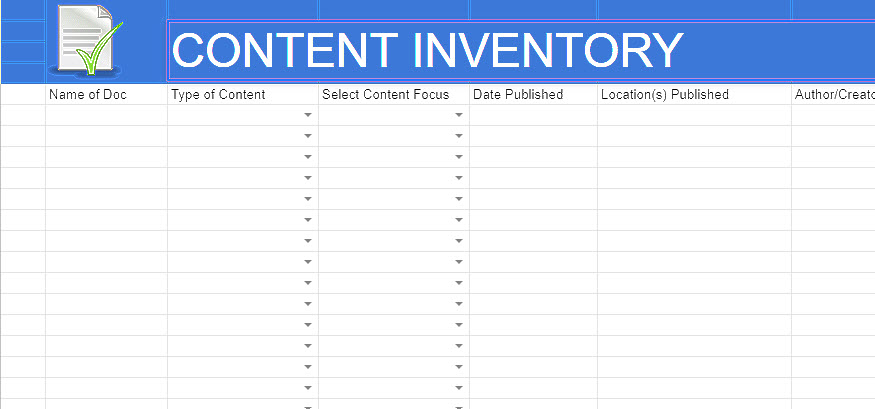
Here is a simple Content Inventory Spreadsheet you can download and customize.
As you document each piece, don’t just think about it from a “now” perspective, but consider how each piece of content fits into your future content strategy. Some data to capture for each piece include:
- Title of the piece.
- URL/where it’s published. This may be multiple places.
- Product or service it supports.
- Any other category of classification, such as supported vertical, or a specific type of customer.
- What stage of the funnel it supports.
- What stage of the customer journey it supports.
- Who wrote it, or developed it.
- Its Call to Action (CTA).
- Publication and/or last edit date.
- SEO data (keywords, phrases).
Capture as much classification data as you can about each piece. You’ll be happy you did later.
When all of this work is done, you can start to perform some data analysis to understand where the gaps are. Maybe you need more Top-of-Funnel awareness-level content for one persona, or perhaps you need to create a program focused on thought-leadership targeting the C-Suite of enterprises you sell into.
I can’t emphasize enough the importance of baselining. Without a baseline, you’re not only going to spend a great deal of time and money on content you possibly didn’t need, but it’s also going to be that much more difficult measuring your successes and providing justification for any additional spending you need as an outcome of these exercises.

 Marcom Today - Portfolio site of Chris Souther